So this issue
came up on fltk.discussions regarding the use of fl_arc(), where
three people including myself were probably more confused than we
should have been about why one of the two forms of the fl_arc()
functions wasn't drawing at all.
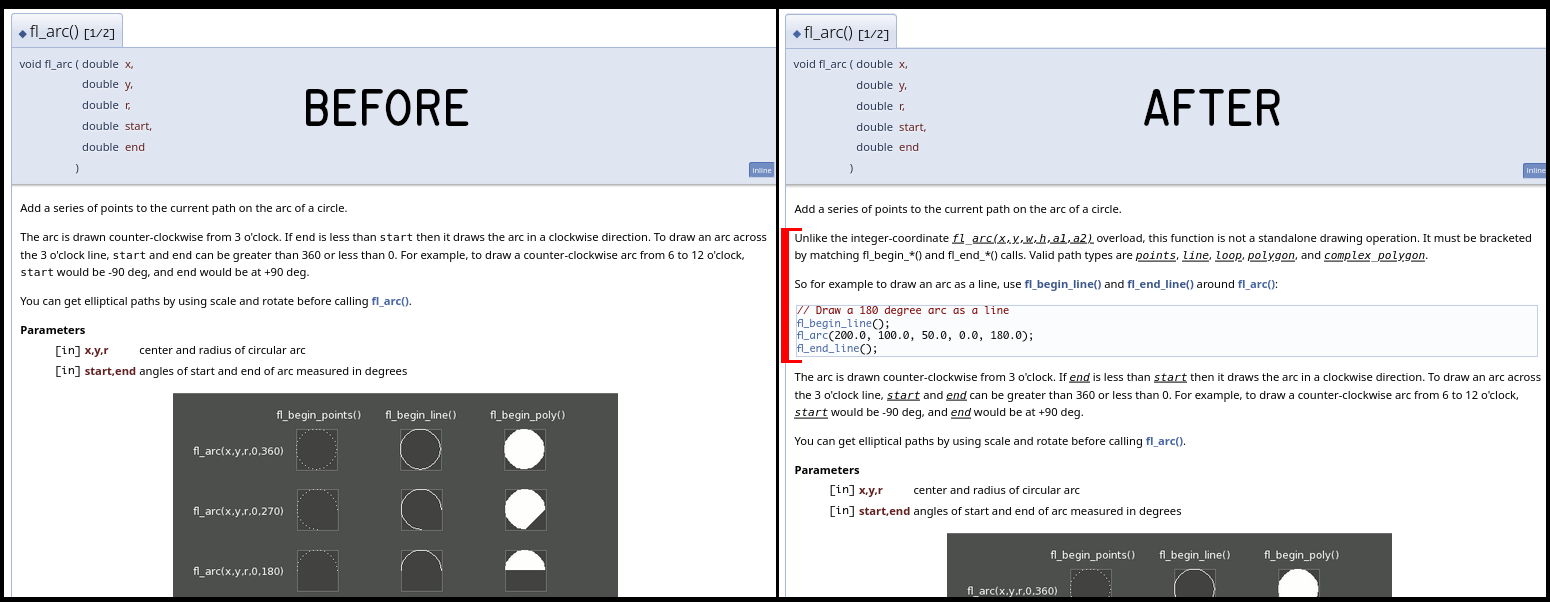
After solving, I offered the confusion could be avoided by a small
clarification in the documentation (red highlighted paragraphs
below):
Normally I would just make the change, but fl_arc() is not a
function I use much, and wanted to make sure in clarifying, I
wasn't missing some other details or drawing contexts, as I think
some of you other developers are more familiar with the internals
of this than I am.
So I'm asking if I missed anything or if there's better wording
needed.
Oh, and the above as a diff:
--- a/FL/fl_draw.H
+++ b/FL/fl_draw.H
@@ -634,6 +634,18 @@ inline void
fl_curve(double X0, double Y0, double X1, double Y1, double
X2, doub
/**
Add a series of points to the
current path on the arc of a circle.
+ Unlike the
integer-coordinate \c fl_arc(x,y,w,h,a1,a2) overload, this
+ function is not a standalone
drawing operation. It must be bracketed by
+ matching fl_begin_*() and
fl_end_*() calls. Valid path types are
+ \c points, \c line, \c loop, \c
polygon, and \c complex_polygon.
+
+ So for example to draw an arc as a
line, use fl_begin_line() and fl_end_line() around
fl_arc():
+ \code
+ // Draw a 180 degree arc as a
line
+ fl_begin_line();
+ fl_arc(200.0, 100.0, 50.0,
0.0, 180.0);
+ fl_end_line();
+ \endcode
The arc is drawn counter-clockwise
from 3 o'clock. If \p end is less than
\p start then it draws the arc in a
clockwise direction. To draw an arc across
the 3 o'clock line, \p start and \p
end can be greater than 360 or less than 0.
@@ -665,6 +677,12 @@ inline void
fl_curve(double X0, double Y0, double X1, double Y1, double
X2, doub
fl_arc(300.0, 100.0, 50.0, 0.0,
180.0);
fl_end_polygon();
\endcode
+
+ \see fl_begin_points(),
+ fl_begin_line(),
+ fl_begin_loop(),
+ fl_begin_polygon(),
+ fl_begin_complex_polygon()
*/
inline void fl_arc(double x, double y,
double r, double start, double end) {
fl_graphics_driver->arc(x, y, r,
start, end);
I think there's another section as well in the "drawing with
fltk" where this info might be duplicated, and thus a similar
change done there as well.
Comments are owned by the poster. All other content is copyright 1998-2026 by Bill Spitzak and others. This project is hosted by The FLTK Team. Please report site problems to 'erco@seriss.com'.